
Somervell County Court Records After a Jail Arrest
After a Somervell County jail arrest, the custody side and the court side develop on different tracks. Local arrests by the Sheriff's Office, Glen Rose Police Department, DPS, constables, game wardens, or another authorized agency may be booked through the sheriff-operated Somervell County Jail. The first court-related step is often the magistrate process under Texas Code of Criminal Procedure Article 15.17, where the arrested person receives required warnings, information about rights, and initial bail consideration. That warning does not always mean a formal criminal case has already been filed.
The formal court record opens when a prosecutor files a complaint, information, indictment, or other charging document with the proper court. Justice of the Peace matters can involve Class C misdemeanors, arraignments, probable-cause warrants, and emergency protective orders. The Somervell County Attorney prosecutes misdemeanor and juvenile offenses, while felony prosecution context routes through the District Attorney. For custody status, booking details, and jail release questions, use jail inmate records. For booking photos or mugshot-request steps, use jail mugshots.
How to Find Court Records After a Somervell County Arrest
The county's court pages link the Tyler Odyssey Portal as the central online path for court records and hearings. The portal is linked by the District Clerk, District Courts, Justice of the Peace, County Attorney, and District Attorney pages. Direct field inspection was not available in the research environment because command-line access returned HTTP 403, so exact search labels should be confirmed in a browser before relying on a specific field name.
- Confirm the custody or booking side first if the arrest is recent. The sheriff and jail line for custody questions is 254-897-2242.
- Open the Tyler Odyssey Portal and search by defendant name or case number if one is known.
- Read the case header, court, charge list, event history, and hearing entries before treating the result as the final disposition.
- If the portal does not show the case, contact the office tied to the offense level: District Clerk for district criminal records, JP for Class C or magistrate matters, County Attorney for misdemeanor or juvenile prosecution context, or District Attorney for felony context.
| Portal or Office | Use It For | Limits |
|---|---|---|
| Tyler Odyssey Portal | Hearing and judicial-record lookup linked by Somervell County court pages. | Field labels were not inspectable from command-line research access. |
| Defendant payment portal | District Clerk-linked defendant access and payments. | Not a jail roster, not proof of custody, and not the same as posting jail bond unless an office confirms it. |
| eFileTexas | Electronic filing for new or existing cases. | Not an inmate locator and not a public mugshot gallery. |
The county's District Clerk page is a key source for district criminal record access and links to the Tyler portal.
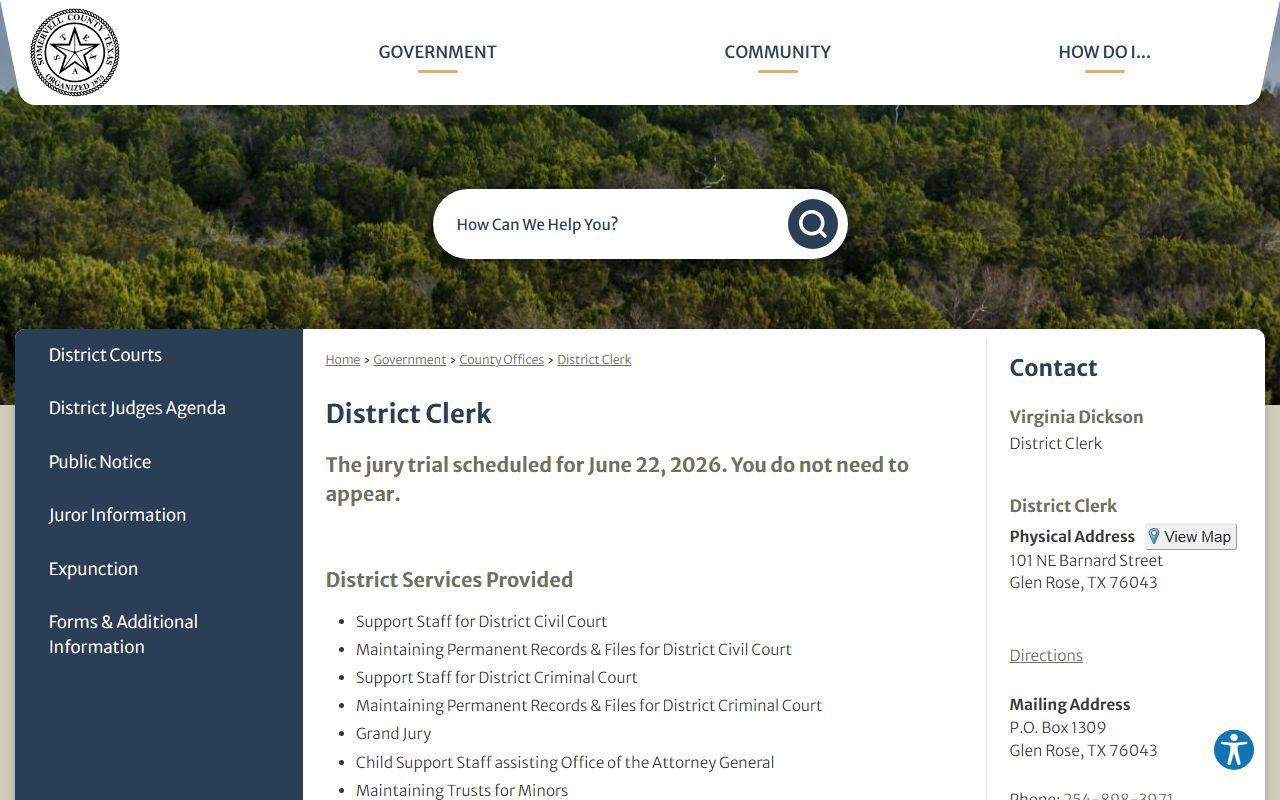
Use the clerk page for the local district-criminal-record office, then use the portal or clerk contact information to narrow a case after the jail arrest.
Which Somervell County Office Handles the Arrest Case
The local arrest-to-court path is split by function. The Sheriff's Office handles custody, booking, jail operations, criminal process service, and custody-related questions at 750 E. Gibbs Boulevard in Glen Rose. The Justice of the Peace, at 102 NE Vine Street, acts as a magistrate, handles adult and juvenile magistrate warnings across all criminal offense classes, conducts Class C arraignments, and may be involved with probable-cause warrants and emergency protective orders.
The Somervell County Attorney, also listed at 102 NE Vine Street, represents the State of Texas in criminal misdemeanor and juvenile prosecutions. The District Attorney office is listed at the Guinn Justice Center, 204 S Buffalo Avenue, Cleburne, TX 76033, phone 817-556-6802, with an e-discovery link for felony prosecution context. District criminal record custody is handled by the District Clerk at 101 NE Barnard Street, Glen Rose, TX 76043, phone 254-898-3971. District Clerk office hours are Monday through Friday, 7:30 a.m. to 4:30 p.m.
Charging Documents After an Arrest: Complaint, Information, and Indictment
A jail booking charge is not the same thing as a filed charging document. Booking reflects the arresting or booking agency's stated basis for custody at intake. A court record after a jail arrest becomes the controlling case record when a prosecutor files charges, amends them, declines them, or presents felony allegations to a grand jury. The exact document matters because it shows who made the formal accusation and where the case is moving.
| Document | Who Uses or Files It | What It Means | Somervell County Context |
|---|---|---|---|
| Complaint | Officer, prosecutor, or authorized complainant depending on case type. | A sworn accusation or charging basis that may begin a lower-level criminal matter. | Relevant to JP and misdemeanor paths, including Class C matters filed by agencies such as DPS, sheriff, constables, game wardens, or other authorized agencies. |
| Information | Prosecutor. | A prosecutor-filed charging document often used for misdemeanor prosecution and some waived-indictment contexts. | County Attorney misdemeanor prosecution may involve filed charges that differ from the original booking language. |
| Indictment | Grand jury. | A formal felony accusation returned after grand-jury review. | Felony context is tied to the District Attorney and district-court record channels. |
Charge Status in Court Records After an Arrest
Charge status can change several times after an arrest. A booking charge may be listed broadly at intake, then the prosecutor may file a different offense level, add counts, reduce a count, dismiss a count, or decline prosecution. Court records after a jail arrest are therefore better for formal charge status than a jail note or custody confirmation. A release from jail also does not necessarily end the court case.
| Status | What It Means | How to Read It |
|---|---|---|
| Pending | The charge or case remains open and has not reached a final disposition. | Check upcoming hearings, bond conditions, and whether the charge is still the same as the booking allegation. |
| Filed | A prosecutor or authorized complainant has placed a charge into the court record. | This is the court side of the case, not merely the jail intake record. |
| Amended or Reduced | The filed charge changed by count, level, language, or offense category. | Use the newest docket entry or charging document instead of the earliest booking label. |
| Dismissed | The charge is no longer being prosecuted in that case. | A dismissal is not automatically an expunction. Chapter 55 eligibility and court orders matter. |
| No Bill or Declined | The charge did not proceed through grand jury or prosecution review. | Confirm whether any related count, lower charge, or new case remains open. |
Bond and Release Records After a Somervell County Arrest
Texas bail is governed primarily by Code of Criminal Procedure Chapter 17, with local decisions made through magistrates and courts. In Somervell County, the Justice of the Peace page is important because it identifies JP magistrate duties, including warnings on all classes of criminal offenses, Class C arraignments, emergency protective orders, and probable-cause warrants. Bond information may appear in court records, jail records, or both, but the accepted method to post a bond should be confirmed with the jail before anyone travels or pays.
| Bond Type | How It Works | Local Checkpoint |
|---|---|---|
| Cash bond | The full bond amount is posted directly if allowed by the court or jail process. | Call 254-897-2242 to confirm amount, payment method, hours, and any holds. |
| Surety bond | A licensed bonding company posts the bond under court and statutory requirements. | Confirm the charge, court, and whether a detainer prevents release. |
| Personal bond or recognizance | The court allows release on written promise and conditions instead of upfront full cash. | Look for magistrate or court order language, not just jail custody status. |
| No-bond hold or agency hold | Release may be blocked by the case, another warrant, a detainer, or another agency's hold. | Ask the jail whether any hold remains after the local bond is addressed. |
Warrants That Lead to an Arrest and Court Record
The sheriff page says the Sheriff's Office serves civil and criminal process, including citations, writs, subpoenas, and warrants. No official Somervell County active-warrant search page or public warrant list was located in the research. That means a warrant-related arrest may require several checks: sheriff custody questions at 254-897-2242, a written law-enforcement public-information request, the Justice of the Peace for Class C or magistrate matters, and the District Clerk or Tyler portal for filed criminal cases or hearing entries.
A person who may have an active warrant should not assume that appearing at a jail or court counter will only produce paperwork. Contact an attorney, the issuing court, or the sheriff or court clerk to understand appearance options, bond status, and possible arrest risk before going in person.
The Somervell County Justice of the Peace page explains the local JP role in magistrate warnings, Class C misdemeanors, warrants, and emergency protective orders.
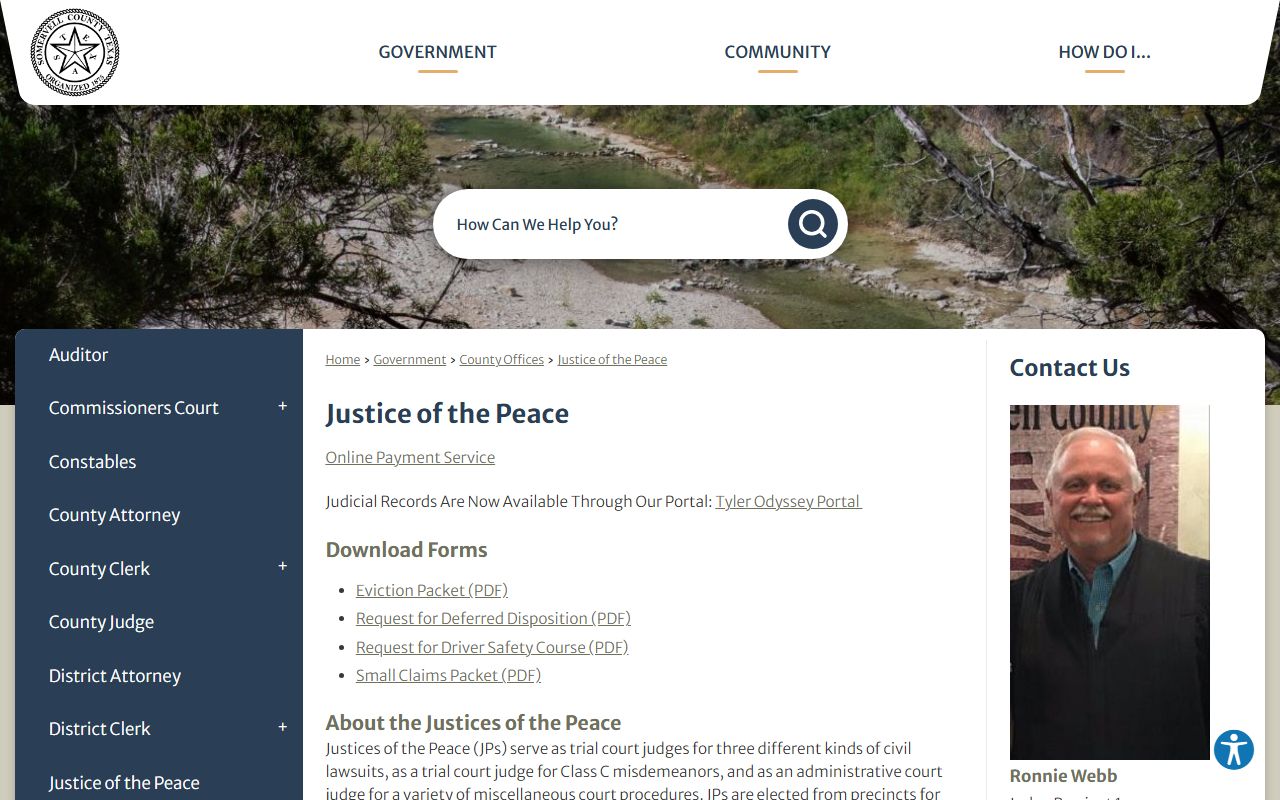
That JP role helps explain why court records after an arrest can involve magistrate action before a prosecutor's final filing decision appears in a case record.
Charges vs. Convictions in Court Records
An arrest, a booking charge, and a conviction are different legal events. Court records after a jail arrest may show accusations long before guilt is decided. A charge can be pending, dismissed, amended, or resolved by plea or trial. A conviction generally requires a guilty plea, no-contest plea accepted by the court, jury verdict, bench finding, or other final judgment allowed by law.
| Point of Comparison | Charge | Conviction |
|---|---|---|
| Stage | Accusation after arrest or prosecutor filing. | Final guilt finding or accepted plea. |
| Proof level | May begin from probable cause or charging review. | Requires proof beyond a reasonable doubt or a valid plea. |
| Can change? | Yes. It may be amended, reduced, added, or dismissed. | Can be appealed, set aside, sealed, or expunged only through specific legal processes. |
| Public-record reading | Do not treat as proof of guilt. | Read the judgment and sentence terms, not only the charge name. |
Sealed vs. Expunged Arrest and Court Records
Texas public access starts with Government Code Chapter 552, but criminal records may be limited by confidentiality laws, privacy rules, court sealing, or expunction. Code of Criminal Procedure Chapter 55 governs expunction of qualifying arrest records. A dismissal or not-guilty result does not by itself prove that every booking, court, or law-enforcement record has disappeared from public access.
| Issue | Sealed or Non-Disclosed | Expunged |
|---|---|---|
| Public visibility | Generally hidden from ordinary public access, subject to the order and statute. | Records are destroyed or treated as unavailable under the expunction order. |
| Law-enforcement access | Some agencies may retain limited access depending on the order and law. | Access is much more restricted and controlled by Chapter 55 and the court order. |
| Common trigger | Eligible dispositions under separate Texas record-limiting procedures. | Qualifying arrest outcomes such as certain dismissals, acquittals, pardons, or other Chapter 55 categories. |
| What to verify | Whether the court actually entered an order and which records it covers. | Whether the expunction order names the sheriff, clerk, prosecutor, and other agencies holding records. |
The county's expunction page is a useful local starting point for record-clearing procedure after an eligible Somervell County arrest.
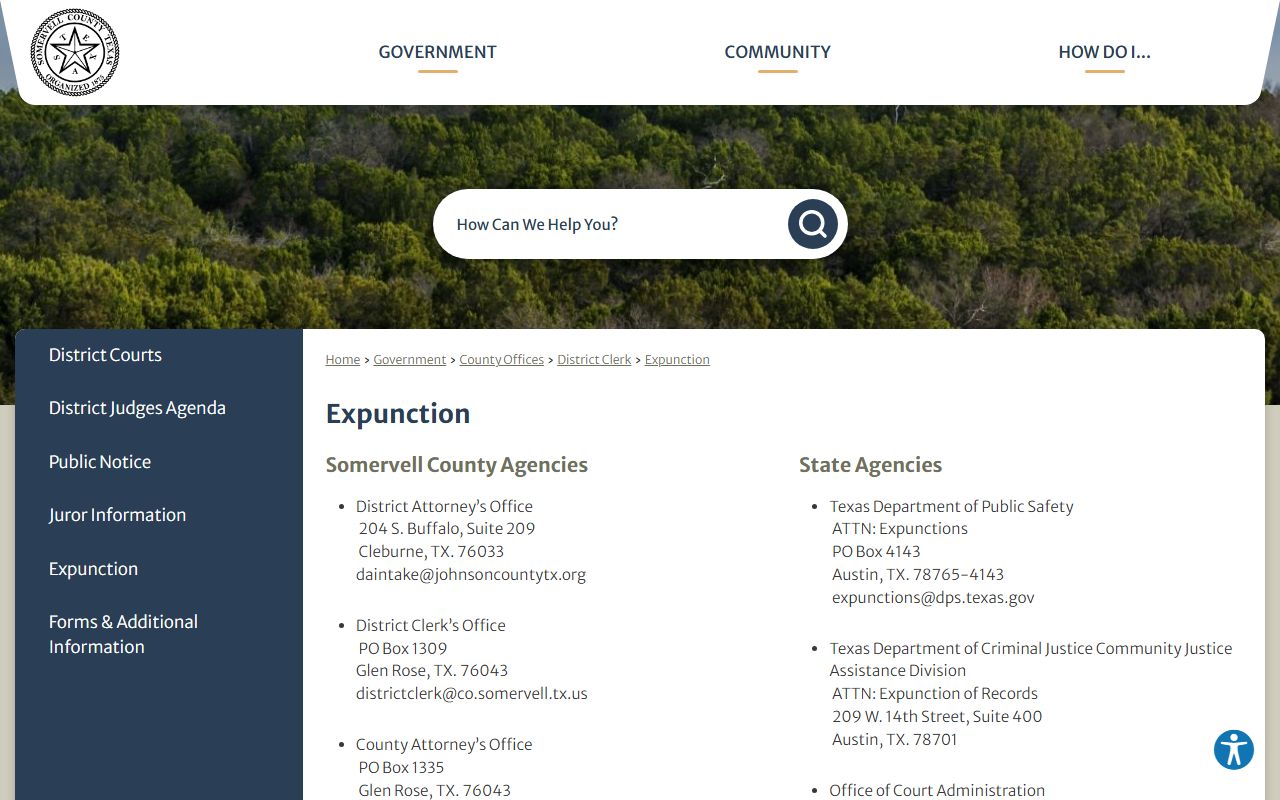
Use expunction information as a court-process reference, not as a promise that a booking photo or court entry will be removed without a qualifying order.
Restricted Court Records After an Arrest in Somervell County
Some arrest-related records may be unavailable to the general public even when related case activity exists. Juvenile matters, sealed records, expunged records, protected victim information, emergency protective order details, confidential identifiers, and active law-enforcement material can be restricted. Law-enforcement exceptions such as Government Code Section 552.108 may also affect a sheriff or booking-record request, especially while an investigation or prosecution is active.
The safest reading method is to separate what each record proves. A jail entry may prove a booking or custody event. A court case may prove a filed charge, hearing, bond order, or disposition. A sealed, expunged, or confidential record may be absent from public search results even though an agency once had it. For official copies, contact the office that created or maintains the record.
Background Check Considerations
Casual searches for court records after a jail arrest are not the same as a legally compliant background check. Employment, credit, insurance, housing, and similar screening decisions can trigger federal and state rules that require proper consumer-reporting procedures, notices, authorizations, dispute rights, and source validation.
Important: Somervell County Inmate Population is not a consumer reporting agency and must not be used for FCRA-covered decisions.